
PORTFOLIO CASE STUDY / SELECTED PROJECT
2025
Redefining LPG Gas Supply & Management
Crown Deluxe is a pioneering digital platform that streamlines bulk LPG gas supply, automated gas station construction services, and real-time delivery tracking for individuals and corporate organizations in Nigeria. The platform bridges the gap between chaotic local energy markets and modern, secure supply chains. As the Lead Product Designer, I spearheaded the research, strategy, structure validation, and high-fidelity interface design for both the consumer mobile experience and the enterprise admin dashboard.
Role
Lead Product Designer
Led research, UX architecture, visual design, and prototype validation.
Scope
End-to-end (0 → 1)
From discovery and positioning to final responsive interface direction.
Platforms
Mobile, Web, Admin, System
A focused sprint with weekly critique, refinement, and prototype checkpoints.
Industry
Fintech / Investment
Reduced ambiguity by turning scattered ideas into a focused product story.
Overview / context paragraph
Most investment platforms optimise for volume. Ethikavest was built for a different kind of investor, one who wants returns to align with values. That premise shaped every design decision, from onboarding flows that communicate trust, to portfolio dashboards that surface impact metrics alongside financial performance.
Understanding the Problem Space
My research revealed that the challenge wasn't simply a lack of investment platforms. It was a combination of religious, financial, technological, and educational barriers that prevented many Nigerians from investing confidently.
PROBLEM 1
No Shariah screening tools
Retail investors had no way to verify if NGX-listed equities were compliant. The platform needed to make that judgment invisible and automatic.
PROBLEM 2
High entry barriers
Existing halal funds required capital most users didn't have. Ethikavest had to make fractional, low-minimum investing feel natural and trustworthy.
PROBLEM 3
Deep regulatory distrust
Nigerian fintech has a credibility problem — platforms disappear with user funds. Every design decision had to communicate safety and legitimacy.
PROBLEM 4
Financial literacy gaps
The target user wasn't a seasoned investor. Complex terms like Sukuk, Mudarabah, and yield needed to feel approachable, not alienating.
PROBLEM 5
Offline user inclusion
Smartphone penetration and reliable internet aren't universal. The product had to reach rural, unbanked users through USSD — a non-visual channel.
PROBLEM 6
Inflation urgency
Uninvested Naira was losing value daily. The onboarding experience needed to convey urgency without triggering anxiety a difficult tonal balance to land.
Design approach / solution
My research revealed that the challenge wasn't simply a lack of investment platforms. It was a combination of religious, financial, technological, and educational barriers that prevented many Nigerians from investing confidently.
DESIGN APPROACH 1
Trust as the primary design layer
My first design priority wasn't the interface. It was trust architecture. With the platform pursuing SEC registration as a digital sub-broker, I had to find ways to make that legitimacy visible and felt throughout the product, not buried in a terms page. That meant a clear, unambiguous onboarding flow, regulatory credentials surfaced at the right moments, and language that never overpromised. Every screen was asking the user to believe in something new. The design had to earn that.
ONBOARDING SCREENS
Easy onboarding flow where users sign-up with either Phone Number or Passwords.
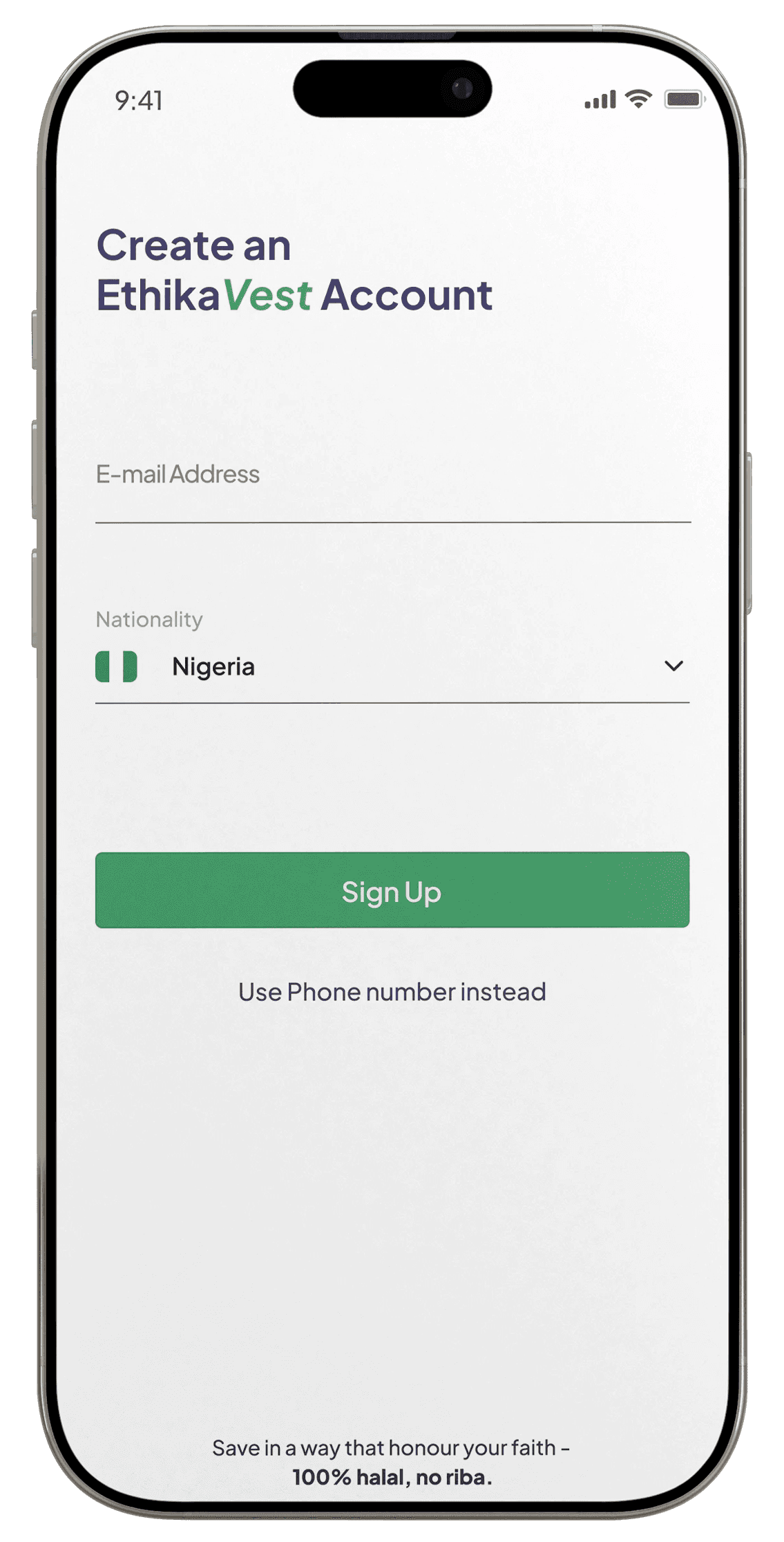


VERIFICATION SCREEN
Easy onboarding flow where users sign-up with either Phone Number or Passwords
DESIGN APPROACH 2
Complexity reduction through AI integration (Amina AI)
One of the more interesting design challenges was integrating Amina AI , the platform's proprietary AI assistant, in a way that felt genuinely useful rather than decorative. The goal was to translate Islamic finance terms into plain, actionable language without stripping them of meaning. I designed the AI touchpoints to feel like a knowledgeable guide rather than a chatbot, appearing contextually within investment flows rather than as a standalone feature users had to seek out.
DESIGN APPROACH 3
Asset presentation, Shariah compliance visibility & portfolio UX
For a platform built on religious conviction, "trust us, it's halal" wasn't good enough, and I designed accordingly. Every stock on Ethikavest, whether listed on the Nigerian Exchange or sourced from foreign markets, carries a visible Shariah compliance rating. Users can see exactly how each equity is screened, what criteria it passed, and where it stands on the compliance spectrum, before committing a single naira. That transparency wasn't cosmetic. It was the core of the value proposition. I designed the compliance layer to sit directly within the investment flow rather than buried in a detail page, so the assurance was present at the moment of decision, not discovered after the fact. The goal was to give users something the broader Nigerian fintech market had never offered them: verifiable confidence that what they were investing in was genuinely, documentably halal.


DESIGN APPROACH 4
Saving and Investing should start small
Designed for fractional investing so users can begin building wealth without needing significant capital. Saving with as low as #100 and with a minimal investment of #12,000


OTHER SCREENS


DESIGN SYSTEM
With four surfaces to design, consistency wasn't optional, it was structural. I built a design system from scratch: a token-based library of components, typography, colour, and interaction patterns that served the mobile app, web platform, and admin dashboard simultaneously. This meant developers could move faster with fewer ambiguities, and future product iterations had a documented, extensible foundation to build from.


Expected User Impact
By addressing these barriers together instead of individually, Ethikavest creates an experience that is both financially empowering and religiously aligned. Users who previously had limited access to ethical investments can begin investing with lower entry barriers.
Those worried about inflation gain access to investment options designed to preserve and grow their purchasing power. Investors seeking halal financial products no longer need to question whether an opportunity aligns with their beliefs, and the platform's regulatory positioning helps strengthen confidence in an industry where trust is often fragile.
Rather than solving a single problem, the goal was to create an ecosystem that makes ethical investing more accessible, understandable, and trustworthy for everyday Nigerians.
What I learned
Ethikavest taught me that designing for underserved markets requires a different kind of empathy — one that accounts for distrust built up over years, not just current user frustration. You can't pattern-match your way through it. The users I was designing for had been burned before. That shaped how I approached every flow, every micro-interaction, every word on screen. The product had to work harder to earn the user's confidence than most fintech apps ever need to.